B2B SaaS Growth Loops: How to Build Self-Reinforcing Growth in 2026
For over a decade, the B2B SaaS industry worshipped the funnel. We built marketing machines designed to pour traffic into the top, meticulously track users as they dropped through various stages of the AARRR framework (Acquisition, Activation, Retention, Referral, Revenue), and celebrate the small percentage that emerged as paying customers at the bottom.
But as we navigate 2026, the traditional funnel has proven fundamentally flawed for modern software companies. Funnels are linear. They operate on addition, requiring a constant, exhausting, and increasingly expensive influx of capital and effort to keep the top full. When you stop pouring money into ads or halting outbound sales, a funnel dries up.
The most successful B2B SaaS companies today—think Figma, Notion, Slack, and Hubspot—do not rely on linear funnels. Instead, they rely on a different mental model entirely: SaaS growth loops.
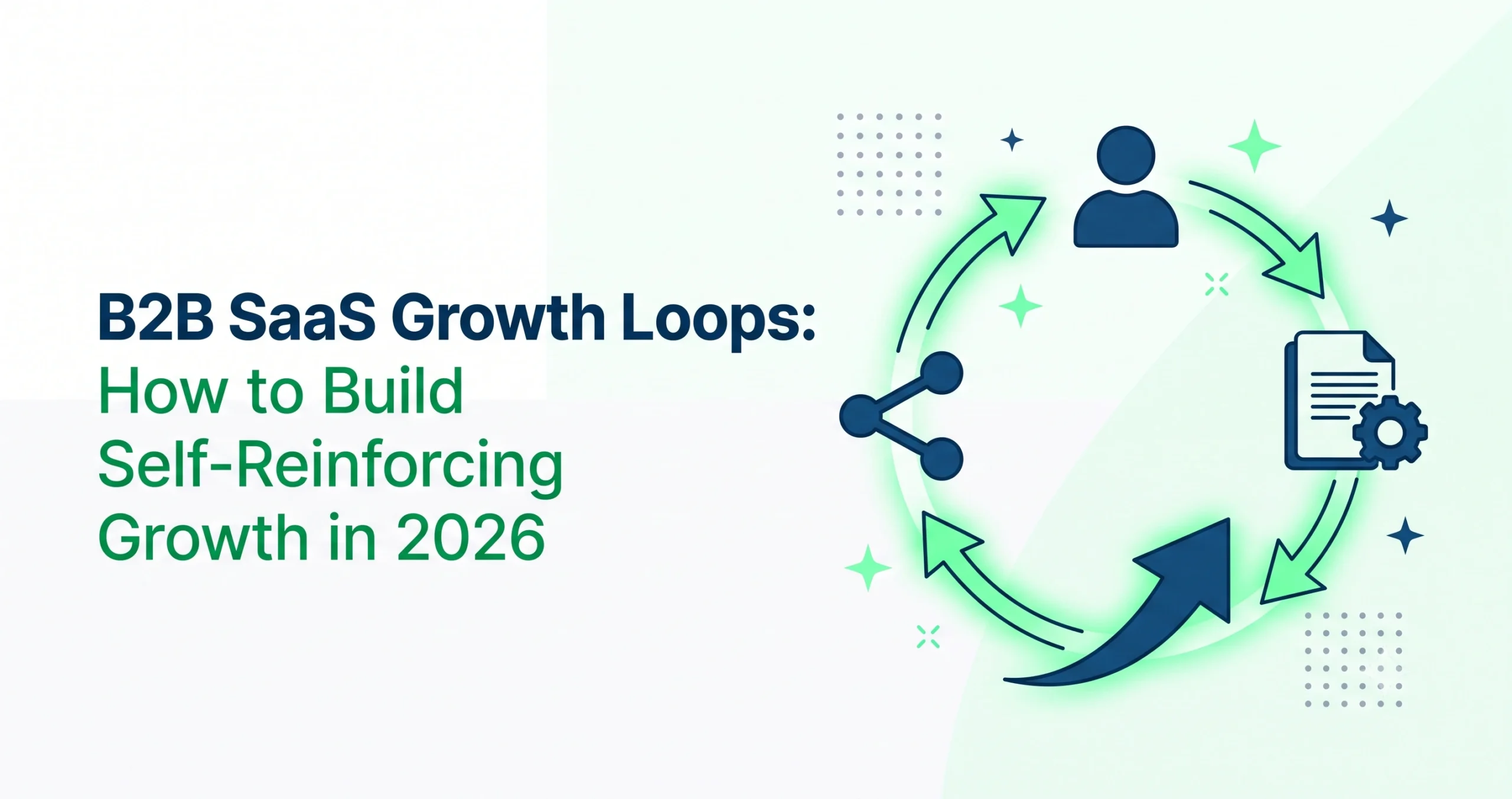
A growth loop is a closed system where the inputs through some process generate more of an output that can be reinvested in the input. In other words, they operate on multiplication. The output of one cycle directly fuels the next, creating a self-reinforcing engine of compounded growth.
This article serves as a capstone guide for NudgeSaaS readers. We are going to deconstruct the mechanics of SaaS growth loops, explore the specific frameworks working in B2B today, and detail how to integrate these loops with your core onboarding, activation, and retention strategies.
What is a Growth Loop and How it Differs from a Traditional Funnel
To understand why SaaS growth loops have become the dominant architectural framework for modern software growth, we must contrast them directly with traditional marketing and sales funnels.
The Leakage Problem of Traditional Funnels
Funnels are inherently designed to leak. You start with 10,000 website visitors. 1,000 sign up for a free trial. 150 reach the activation milestone. 20 become paying customers.
This linear system has three critical vulnerabilities:
- It creates siloed thinking: Marketing owns the top of the funnel (acquisition), Product owns the middle (activation/retention), and Sales/Customer Success owns the bottom (revenue/referral). These teams often optimize for their specific stage rather than the holistic user journey.
- Customer Acquisition Cost (CAC) constantly rises: Because funnels require you to constantly refill the top, you are forced to compete in increasingly saturated channels (paid search, social ads, outbound), driving up the cost of every new lead.
- Growth is additive, not compounding: If you want to double your customer base in a funnel model, you generally need to double your marketing budget or your sales headcount.
The Compounding Power of Growth Loops
SaaS growth loops, on the other hand, are closed, self-sustaining systems. They integrate product, marketing, and sales into a single, cohesive engine.
Instead of looking at how many users drop out of a stage, a growth loop looks at how a user’s successful interaction with the product naturally generates the next user. When a loop is functioning correctly, it compounds. Acquiring a cohort of 100 users doesn’t just result in revenue; it results in those 100 users automatically pulling in 120 new users through natural product usage, word of mouth, or generated capital.
In a funnel, you feed the machine. In a loop, the machine feeds itself.
Anatomy of a Growth Loop
Every effective SaaS growth loop, regardless of its specific type or industry application, relies on a three-part anatomical structure: Input, Action, and Output, followed by Reinvestment.
1. The Input
The input is the raw material that enters the loop. This could be a new user signing up, a piece of user-generated content, or a specific amount of capital generated from a subscription payment. Without an initial input, the loop cannot begin to spin.
2. The Action
Once the input enters the system, a specific action must occur. This is where product design and user experience become critical. The action must be something the user naturally wants or needs to do to get value out of your software.
Crucially, this action must involve little to no friction. If the user is a new signup (Input), the action might be them creating their first collaborative dashboard, sending a document for signature, or publishing a landing page on your platform.
3. The Output
The action must yield an output. This output is the yield of the user’s interaction with the product. Depending on the loop, the output could be an invitation sent to a colleague, a piece of indexable content created on the web, a viral social media share, or cold hard cash.
4. Reinvestment (Closing the Loop)
This is the step where funnels and loops diverge. In a funnel, the output is the end of the line. In a growth loop, the output is directly reinvested to become the new Input for the next cycle.
If the output is an invitation, that invitation brings a new user (Input) to the platform. If the output is an indexable landing page, that page ranks on Google, bringing organic traffic (Input) to the platform. If the output is subscription revenue, that exact revenue is immediately deployed into highly optimized paid acquisition to acquire a new user (Input).
Types of Growth Loops Relevant to B2B SaaS
Not all loops are created equal. The most successful B2B SaaS companies usually operate one primary macro-loop, supported by several micro-loops. In 2026, we see five dominant types of SaaS growth loops.
1. Content Loops (User-Generated and Company-Generated)
Content loops leverage the creation of assets to drive organic discovery.
- User-Generated Content (UGC) Loops: Think of Miro, Notion, or Airtable.
- Input: A new user signs up.
- Action: The user creates a valuable template, dashboard, or public workspace.
- Output: The user publishes this template to a community gallery or shares it publicly, creating an SEO-indexed page.
- Reinvestment: Non-users search for “agile sprint planning template” on Google, find the user-generated page, and sign up for the platform to use it.
- Company-Generated Content Loops: Think of programmatic SEO (like Zapier or G2).
- Input: Capital/Revenue.
- Action: The company scales programmatic creation of landing pages (e.g., “Connect App A to App B”).
- Output: Thousands of highly specific, low-volume search pages rank on Google.
- Reinvestment: Searchers land on these pages, sign up, and generate revenue, which funds the creation of more programmatic content.
2. Product-Led (Collaboration) Loops
This is the holy grail of modern Product-Led Growth (PLG). This loop relies on the inherent multiplayer nature of a product. Single-player mode is valuable, but multiplayer mode is essential.
- Input: A single user inside an organization signs up (e.g., a designer joining Figma).
- Action: To get their work approved, the user must share their design with a stakeholder.
- Output: The platform sends a branded invitation or a shareable link to the stakeholder (e.g., a product manager).
- Reinvestment: The product manager clicks the link, creates a free account to view or comment on the design, and becomes a new user (Input).
3. Referral and Viral Loops
While collaboration loops are driven by necessity (I must share this to do my job), referral loops are driven by incentive (I will share this to get a reward).
- Input: An active, satisfied user.
- Action: The product prompts the user to refer a colleague in exchange for extended trial time, premium features, or account credits.
- Output: The user sends personalized referral links to their network.
- Reinvestment: The network clicks the links, signs up to claim their own incentive, and enters the product.
4. Paid Acquisition Loops
Paid marketing is often viewed as a linear funnel, but highly optimized SaaS businesses turn it into a financial loop. This requires a deep understanding of unit economics.
- Input: Initial capital investment in paid ads (LinkedIn, Google Ads).
- Action: Targeted accounts see the ad, click, and convert into paying customers.
- Output: The customer pays their first month’s subscription, generating immediate cash flow.
- Reinvestment: If the payback period is incredibly short (e.g., the customer’s first-month payment covers their specific Customer Acquisition Cost), that revenue is immediately piped back into the ad platform to acquire the next user.
5. Sales-Assisted (Land and Expand) Loops
Enterprise B2B SaaS relies heavily on the “Land and Expand” loop. This combines product-led mechanics with targeted sales intervention.
- Input: A small team (3-5 users) within a large enterprise adopts the product self-serve.
- Action: The team hits a usage threshold or usage limit.
- Output: This triggers a Product-Qualified Lead (PQL) alert to the internal sales team.
- Reinvestment: Sales reaches out, not to cold pitch, but to offer an enterprise-wide license, SSO integrations, and advanced security. The account upgrades, spreading the software to adjacent departments, generating new users (Input) within the same massive organization.
How to Design a Growth Loop for a Generic B2B SaaS Product
Building SaaS growth loops is an exercise in product engineering as much as it is in marketing. Here is a step-by-step framework for designing a self-reinforcing loop from scratch.
Step 1: Identify Your Product’s Natural “Export” or “Share” Value
You cannot force a loop that contradicts user behavior. Ask yourself: Why would my user ever expose this product to a non-user?
- Do they need to send a report to a client?
- Do they need to collaborate with a vendor?
- Does the product generate an artifact (a video, a document, a widget) that lives on the public internet? Find the natural point of friction where a single-player experience must cross over into the public or multiplayer domain.
Step 2: Map the Action Step to Core Product Value
The action that drives the loop must be tied to the core reason the user bought the software. If you run a video hosting SaaS, the action is “embedding the video on a website.” If you run a scheduling tool, the action is “sending a calendar link.” Make this action the absolute easiest thing to do in your software.
Step 3: Design the Output Artifact
When the user takes the action, what is generated? If it is a shared link, design the landing page the recipient sees. It shouldn’t just be a wall of data; it should clearly say, “This was made with [Your SaaS] – Click here to make your own.” If it is an embedded widget, ensure there is a tasteful “Powered by…” badge. The output artifact is your billboard.
Step 4: Engineer the Reinvestment Path
How does the person who sees the Output become an Input? Reduce all friction from the recipient’s journey. If a non-user clicks a shared link from an existing user, do not force them through a generic homepage and a 10-field signup form. Drop them into a contextual, magic-link signup flow that immediately places them into the shared workspace they were invited to.
Common Mistakes: Building a Loop That Doesn’t Close
The landscape of B2B SaaS is littered with the remains of companies that thought they built a growth loop, but actually just built a funnel with a “Share on Twitter” button tacked onto the end.
Here are the most common ways companies fail when designing loops:
1. The “Dead End” Loop (Failing to Close)
This is the most frequent error. A company builds a great feature that generates an output, but that output doesn’t feed back into the input. Example: A SaaS reporting tool allows users to export data as a static PDF to email to their clients. The client reads the PDF, gets the value, and deletes the email. The loop is broken. The Fix: Change the export from a static PDF to a dynamic, hosted web link. When the client clicks the link, they view the report in a branded environment that invites them to create their own free reporting dashboard.
2. Forcing the Loop Before Activation
You cannot ask a user to invite their coworkers or share a public template before they have experienced the “Aha!” moment of your product. If you place a referral prompt immediately after signup, before the user has done any meaningful work, your conversion rate will be zero. You must deliver value before you extract distribution.
3. Misaligning the Incentive
In referral loops, companies often offer the wrong reward. Offering a $25 Amazon gift card for a B2B enterprise referral rarely works, because the user isn’t motivated by a minor personal financial kickback when their professional reputation is on the line. Instead, reward them with product value: premium integrations, higher API limits, or priority support.
How Growth Loops Connect to Onboarding, Activation, and Retention
For a SaaS growth loop to spin at maximum velocity, it must be deeply integrated with your broader product strategy. As we frequently discuss at NudgeSaaS, acquisition means nothing without activation, and activation means nothing without retention.
Onboarding: The Lubricant of the Loop
User onboarding is how you minimize friction at the “Input” stage of the loop. If a new user is generated by a viral loop (e.g., they clicked a colleague’s invite link), their onboarding experience should be radically different from a cold-traffic user. Contextual onboarding is key. Instead of a generic product tour, drop them directly into the artifact they were invited to collaborate on. The faster they understand the context, the faster they transition from Input to taking an Action.
Activation: The Trigger for the Loop
Activation is the exact moment a user realizes the value of your product. A loop should theoretically only be presented to activated users. If your activation metric is “User connects their CRM and imports 100 contacts,” that is the precise moment you introduce the collaboration or referral loop. Activation creates the goodwill and trust necessary for the user to willingly generate the Output your loop requires.
Retention: The Engine of the Loop
A funnel is concerned with acquiring a user once. A loop relies on retaining a user long enough for them to cycle through the loop multiple times. If your churn rate is high, your loops will break down. A user who churns in month two will never invite their new team members in month six. Retention acts as the multiplier on your growth loop. The longer a user stays, the more iterations of the Action/Output cycle they complete, continually feeding the top of your system.
How to Measure and Optimize a Growth Loop
You cannot optimize what you do not measure. Traditional funnel metrics (Cost Per Click, Lead-to-Opportunity Ratio) are insufficient for measuring loop health. To evaluate your SaaS growth loops, you must track velocity and cyclical conversion rates.
1. The Viral Coefficient (K-Factor)
The K-factor measures how many new users each existing user brings in. Formula: K = (Number of invites sent per user) x (Conversion rate of those invites). If K is greater than 1, your product is growing exponentially (virally). If K is 0.2, it means for every 10 users you acquire, they generate 2 new users. In B2B SaaS, a K-factor of >0.15 is generally considered a strong, healthy supplementary loop.
2. Loop Velocity (Cycle Time)
Velocity measures how long it takes for a user to go from Input to generating a successful Reinvestment. If a user signs up today, how many days does it take them to invite a colleague who also signs up? If your cycle time is 90 days, your loop will grow slowly. If you can optimize product design to reduce that cycle time to 7 days, your compounding growth curve will steepen dramatically.
3. Funnelling the Loop (Micro-Conversions)
While the macro-model is a loop, the individual steps inside the loop act like micro-funnels. You must measure the conversion rate between each node:
- Input-to-Action Rate: What percentage of new users take the core loop-driving action?
- Action-to-Output Rate: When the action is taken, how often is the output successfully generated?
- Output-to-Reinvestment Rate: When a non-user sees the output (e.g., clicks a shared link), what percentage convert into new users?
By mapping these specific conversion rates, you can identify exactly where your loop is losing momentum and deploy product engineering or UX changes to fix the bottleneck.
Conclusion: The Era of Compounding Growth
The shift from funnels to SaaS growth loops is not merely a change in marketing terminology; it is a fundamental shift in how software businesses are built. In 2026, the companies that win will not be those with the largest advertising budgets. The winners will be those who construct elegant, frictionless products that naturally pull the market toward them.
By designing precise actions, generating valuable outputs, and seamlessly reinvesting those outputs into your acquisition engine, you transform your user base into your most powerful growth channel. Tie this tightly to world-class onboarding, rapid activation, and deep retention, and you will build a self-reinforcing engine capable of sustaining long-term market dominance.
Frequently Asked Questions (FAQ)
1. Can a B2B SaaS company survive on a growth loop alone without traditional marketing?
While some product-led giants (like Atlassian in its early days) grew almost entirely via loops, most modern B2B SaaS companies use a hybrid approach. Traditional marketing (paid ads, content, outbound) is used to provide the initial “Input” or fuel to get the flywheel spinning, while the growth loop handles the compounding scale and lowers the blended Customer Acquisition Cost (CAC) over time.
2. How long does it take to see the compounding effects of a growth loop?
Because loops operate on multiplication, the initial growth can look deceptively flat. It typically takes 3 to 6 months of a functioning loop before the compounding effect becomes noticeable on a revenue chart. This is driven by your Loop Velocity (cycle time); the faster users complete the loop, the sooner the compounding curve steepens.
3. Are growth loops only for Product-Led Growth (PLG) companies?
No. While PLG companies naturally lean into product-collaboration loops, enterprise sales-led companies can build loops as well. These often take the form of Sales-Assisted loops (where usage data triggers internal expansion), or macro-financial loops (where specific LTV targets strictly govern reinvestment into ABM campaigns).
4. What is the biggest barrier to implementing a SaaS growth loop?
Organizational silos. Loops require a seamless handoff between marketing (who brings the initial input), product (who designs the action and output), and sales (who capitalizes on the reinvestment). If these teams have conflicting KPIs—for example, if marketing is solely measured on raw MQLs rather than activated loop participants—the system will break.
5. How do I know if my product naturally supports a collaboration loop?
Look at how your users currently behave outside of your software. Are they taking screenshots of your dashboard to put into Slack? Are they exporting CSVs to send to their boss? Are they sharing their login credentials with a freelancer? These “hacky” workarounds are massive flashing indicators that your users want a multiplayer experience. Build the loop to facilitate what they are already trying to do.