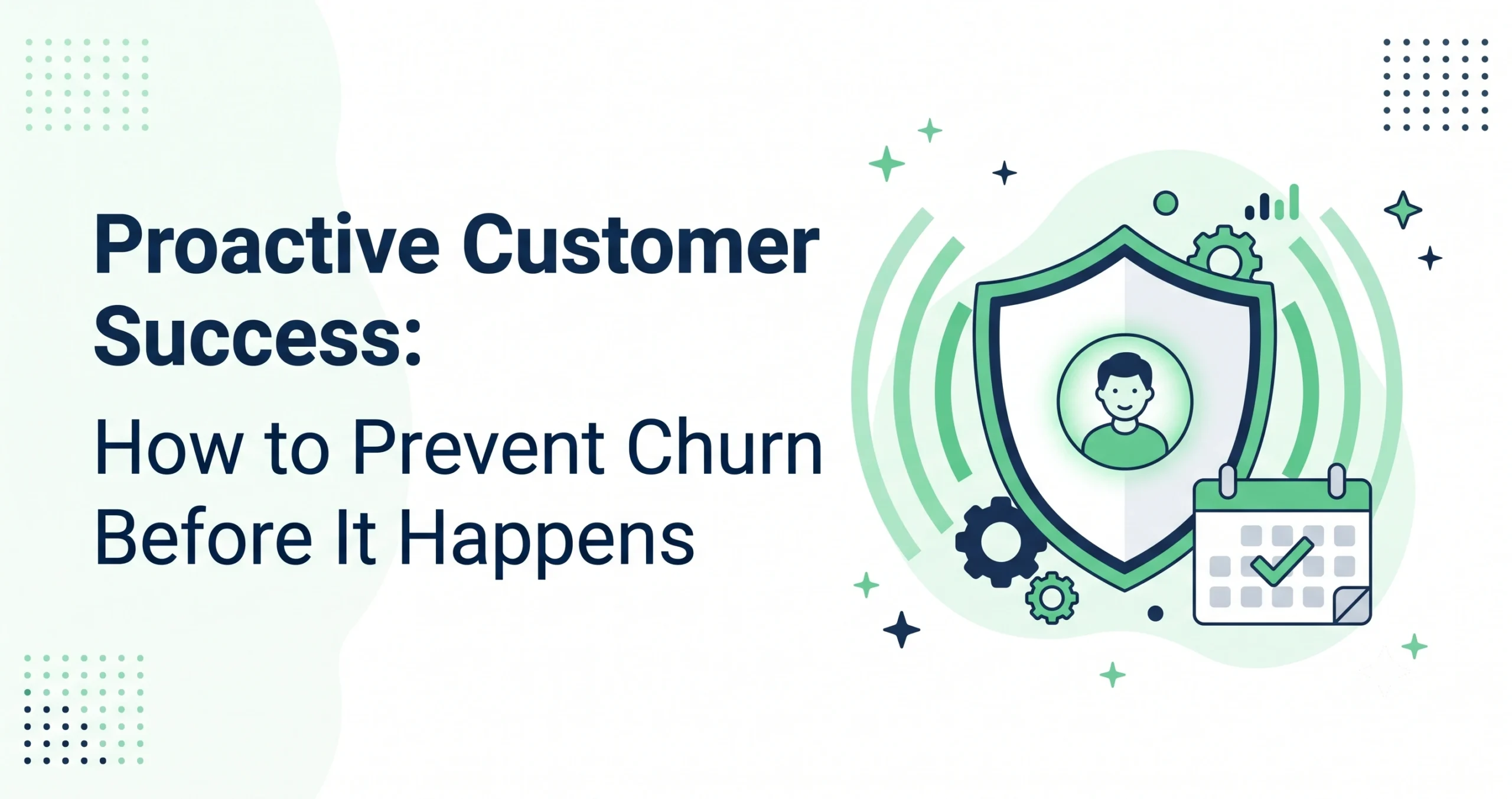
Proactive Customer Success: How to Prevent Churn Before It Happens
In the fast-paced world of SaaS, relying on a reactive approach to customer management is a recipe for disaster. Most software companies inadvertently run their Customer Success (CS) departments like glorified support desks. They wait for a support ticket to drop, an executive escalation to sound the alarm, or a renewal deadline to approach before they finally spring into action. This reactive, support-ticket-driven model treats symptoms rather than the underlying disease. By the time a customer reaches out with a major complaint or asks to cancel, their mind is often already made up.
Contrast this with proactive customer success. Proactive CS is the strategic, data-driven practice of anticipating customer needs, guiding them toward value, and mitigating risks long before they turn into actual problems. Instead of putting out fires, proactive customer success builds fireproof houses. For modern SaaS companies, transitioning from a reactive stance to a proactive methodology isn’t just an operational upgrade; it’s a fundamental requirement for sustainable growth.
In this comprehensive guide by NudgeSaaS, we will explore exactly how to build a proactive customer success motion that prevents churn, drives product adoption, and turns your user base into a powerful growth engine.
1. What Proactive Customer Success Means (and Why It’s a Competitive Advantage)
At its core, proactive customer success is about driving the customer’s journey rather than just going along for the ride. It means you understand the milestones your customer needs to hit to achieve their desired business outcomes, and you actively guide them toward those milestones.
In a reactive model, the customer takes the lead. If they don’t log in, you don’t speak to them. If they don’t adopt a new feature, you assume they don’t need it. Proactive CS flips this dynamic. It leverages product telemetry, behavioral data, and strategic playbooks to intervene exactly when the customer needs guidance—even if they don’t know they need it yet.
The Competitive Advantage of Being Proactive:
- Drastic Churn Reduction: Churn is rarely a sudden event; it is a slow fade. Proactive customer success allows you to identify the early symptoms of this fade (like declining logins) and intervene months before the renewal date.
- Increased Net Revenue Retention (NRR): When CSMs aren’t bogged down fixing immediate, reactive issues, they have the bandwidth to identify expansion, cross-sell, and up-sell opportunities.
- Enhanced Brand Loyalty: Customers want partners, not just vendors. When a CSM reaches out to say, “I noticed you haven’t set up the new analytics dashboard yet—here’s how it can save your team 5 hours a week,” it builds immense trust.
- Operational Scalability: Reactive models scale linearly (more customers = more tickets = more CSMs). Proactive models leverage automation and data, allowing a single CSM to manage a larger portfolio effectively.
2. Building a Customer Health Score
You cannot practice proactive customer success without knowing exactly where your customers stand at any given moment. A Customer Health Score is a quantitative metric that reflects the likelihood of a customer renewing, expanding, or churning.
Building an effective health score requires looking at a composite of multiple data points, typically weighted by their impact on your specific business model. Here are the five foundational pillars of a robust health score:
Usage Frequency (The Pulse)
How often is the customer logging into your platform? Are they a daily active user (DAU), or do they only log in once a month? Declining login frequency is the most glaring indicator of impending churn.
- Weighting Strategy: High weight. If they aren’t using the product, nothing else matters.
Feature Adoption Breadth (The Depth)
Are they using the “sticky” features of your platform? If a user buys a robust marketing automation tool but only uses it to send simple batch-and-blast emails, their adoption breadth is low. They aren’t getting the full ROI, making them highly susceptible to cheaper alternatives.
- Weighting Strategy: Medium-High weight. Track specific “aha! moment” features and heavily weight the adoption of those key functionalities.
Support Ticket Volume (The Friction)
While a complete lack of support tickets might mean a lack of engagement, an excessive number of support tickets indicates severe friction. Are they constantly encountering bugs? Are they struggling to understand the UI?
- Weighting Strategy: Medium weight. Look for spikes in volume or repeated tickets about the same integration or feature.
Net Promoter Score (NPS) and CSAT (The Sentiment)
Quantitative data tells you what the customer is doing; qualitative sentiment data tells you how they feel about it. Regular NPS surveys or post-interaction Customer Satisfaction (CSAT) scores give you a direct line to user sentiment.
- Weighting Strategy: Medium weight. While important, NPS can sometimes be a lagging indicator or represent the view of an end-user rather than the economic buyer.
Stakeholder Engagement (The Relationship)
Are you talking to the people who hold the purse strings? If your primary champion leaves the company, or if the executive sponsor stops showing up to Quarterly Business Reviews (QBRs), your account is at risk, regardless of how often frontline employees log in.
- Weighting Strategy: High weight for Enterprise accounts. If the economic buyer is disengaged, a churn event is highly probable.
How to Weight These Factors: A standard formula might look like this: Usage Frequency (35%) + Feature Adoption (25%) + Stakeholder Engagement (20%) + Sentiment/NPS (10%) + Support Friction (10%) = Overall Health Score (0-100).
3. Setting Up Early-Warning Triggers for At-Risk Accounts
A health score is excellent for a high-level overview, but proactive customer success requires real-time action. This is where early-warning triggers come into play. Triggers are automated alerts that notify the CS team when a customer exhibits a specific risky behavior, allowing for immediate intervention.
Common early-warning triggers include:
- The “Ghosting” Trigger: The account has had zero logins in the last 14 days, or a key stakeholder has ignored three consecutive emails.
- The Champion Departure: Your primary point of contact changes their LinkedIn title or their email bounces. This is a critical trigger—champion churn often precedes account churn.
- The Usage Drop-Off: Overall account usage drops by more than 20% week-over-week.
- The Failed Payment/Downgrade: A credit card fails or a user turns off auto-renew.
- The Stalled Onboarding: A new customer fails to complete the core onboarding milestones within the first 30 days of signing the contract.
When a trigger fires, the CSM shouldn’t just send a generic “just checking in” email. The outreach must be contextual. For example, if the usage drop-off trigger fires, the CSM should look at where the drop occurred and reach out with targeted help regarding that specific workflow.
4. Proactive Playbooks: Orchestrating the Customer Journey
To scale proactive customer success, your team cannot rely on ad-hoc outreach. You need standardized, repeatable playbooks. A playbook outlines the exact steps, cadences, and resources a CSM should use in specific scenarios.
Check-in Cadences by Account Tier
Not all customers require the same level of touch.
- Tier 1 (Enterprise/Strategic): High-touch. Bi-weekly syncs, deep-dive strategy sessions, and bespoke reporting.
- Tier 2 (Mid-Market): Scaled-touch. Monthly check-ins focused on feature adoption and overcoming specific roadblocks.
- Tier 3 (SMB/Long-Tail): Tech-touch. Primarily automated outreach, with human intervention only when health scores drop below a certain threshold.
Milestone Celebrations
Proactive CS isn’t just about fixing problems; it’s about celebrating wins. Create playbooks for when a customer hits their 10,000th transaction, saves their first 100 hours of labor, or reaches their one-year anniversary. Sending a personalized note, a small gift, or a digital badge reinforces the value your platform provides.
Quarterly Business Reviews (QBRs)
The QBR (or Executive Business Review) is the cornerstone of proactive relationship management. Playbooks should dictate that QBRs are not meant to be a recap of support tickets. Instead, they must focus on:
- Reviewing the initial business goals set during onboarding.
- Proving the ROI achieved in the last 90 days.
- Aligning on strategic goals for the next 90 days.
Feature Adoption Campaigns
When a new product update drops, don’t just rely on marketing to send a newsletter. Have a CS playbook where CSMs identify which specific accounts would benefit most from the new feature and personally guide them through the setup process.
5. How to Combine Automated Nudges with Human CS Outreach for Scale
If you try to implement proactive customer success entirely manually, your CSMs will burn out. True scale is achieved by blending automated technology—like the tools we build here at NudgeSaaS—with strategic human empathy.
The Tech-Touch Layer (Automated Nudges): Leverage in-app messages, tooltips, and automated email sequences for standard lifecycle events.
- Example: If a user navigates to a complex reporting dashboard but leaves without saving a report, an automated in-app nudge can pop up with a 30-second tutorial video.
- Example: If a user hasn’t logged in for 7 days, an automated email can highlight a quick tip or a new case study to draw them back into the platform.
The High-Touch Layer (Human Outreach): Human CSMs should be reserved for high-value interactions that require strategy, empathy, and negotiation.
- Example: The automated system detects that a customer is repeatedly viewing the “Upgrade to Pro” pricing page. This triggers a Slack alert to the CSM, who then reaches out with a tailored ROI calculation to facilitate the upsell.
- Example: An automated health score drops to “Red.” The automated system pauses generic marketing emails to this account, and the CSM steps in to conduct a deep-dive rescue mission.
By letting automation handle the repetitive, educational nudges, you free up your human CSMs to act as strategic consultants rather than technical support reps.
6. Building a Renewal and Expansion Motion That Starts on Day One
In reactive customer success, the “renewal process” starts 30 to 60 days before the contract expires. The CSM scrambles to prove value, hopes the customer remembers what they accomplished six months ago, and begs for a signature.
In proactive customer success, the renewal motion starts on day one of the customer’s lifecycle.
- The Handoff: During the sales-to-CS handoff, the exact business outcomes the customer purchased the software for must be documented.
- Continuous Value Realization: Every interaction, check-in, and QBR should tie back to those initial goals. “You bought our software to reduce manual data entry by 20%. Let’s look at the dashboard and see that we’ve currently reduced it by 25%.”
- Seeding Expansion: Proactive CSMs are always listening for new business challenges. If a customer mentions their marketing team is struggling, and your software has a marketing add-on, the CSM plants the seed early.
- The Non-Event Renewal: If you have spent 11 months proactively guiding the customer, delivering value, and validating their success, the 12th month isn’t a negotiation. The renewal becomes a natural, friction-free continuation of a successful partnership.
7. How to Structure a CS Team Around Proactive Workflows
To execute a proactive strategy, your CS organization must be structured correctly. If your CSMs are constantly bogged down by billing questions and technical bug triage, they cannot be proactive.
Segmentation by Account Value and Complexity:
- Dedicated/Named CSMs: Assigned to your highest Annual Recurring Revenue (ARR) accounts. They manage a small portfolio (e.g., 10-30 accounts) so they can deeply understand the customer’s business and proactively drive strategy.
- Pooled/Scaled CS: For your mid-tier and long-tail customers, use a pooled model. Instead of a dedicated CSM, customers have access to a team of CS specialists. The team operates proactively by responding to health score drops and early warning triggers generated by the entire segment, rather than manually monitoring individual accounts.
Role Specialization: Remove reactive tasks from the CSM’s plate.
- Have a dedicated Customer Support team for break/fix technical issues.
- Utilize Onboarding Specialists (or Implementation Managers) to handle the heavy lifting of the first 30-90 days, ensuring the account is healthy before it transitions to the long-term CSM.
- Consider CS Operations (CS Ops) to build the playbooks, manage the health scoring system, and configure the automated nudges in your CS platform.
By siloing reactive tasks and providing the right operational infrastructure, you empower your CSMs to focus 100% of their energy on proactive growth and retention.
Frequently Asked Questions (FAQ)
1. What is the main difference between Customer Support and Customer Success? Customer Support is inherently reactive; it focuses on resolving specific technical issues, bugs, or questions (break/fix) as they arise. Customer Success is proactive; it focuses on the long-term strategic goals of the customer, ensuring they achieve their desired business outcomes using your product.
2. How do I start implementing proactive customer success if my team is currently overwhelmed with support tickets? Start small by separating the roles. Clearly define what constitutes a “support ticket” and route those away from your CSMs. Then, pick one proactive playbook to implement—such as an automated onboarding sequence or a simple churn-risk trigger—and gradually build out your proactive motions from there.
3. What is a “good” customer health score? A good health score is one that accurately predicts customer behavior. There is no universal number, as the metrics depend entirely on your specific software. However, a well-calibrated health score system should consistently flag accounts as “at-risk” at least 3-6 months before they actually attempt to churn.
4. Can proactive customer success be entirely automated? No. While automation is critical for scaling (especially for lower-tier accounts), high-value accounts require human empathy, strategic alignment, and relationship building. The best approach is a hybrid model where automation handles routine nudges and alerts human CSMs when strategic intervention is needed.
5. How do we measure the ROI of a proactive customer success team? The primary metrics for measuring CS ROI are Net Revenue Retention (NRR), Gross Revenue Retention (GRR), and Customer Lifetime Value (CLTV). A successful proactive CS motion will clearly demonstrate a reduction in churn (increasing GRR) and an increase in upsells and cross-sells (pushing NRR well above 100%).