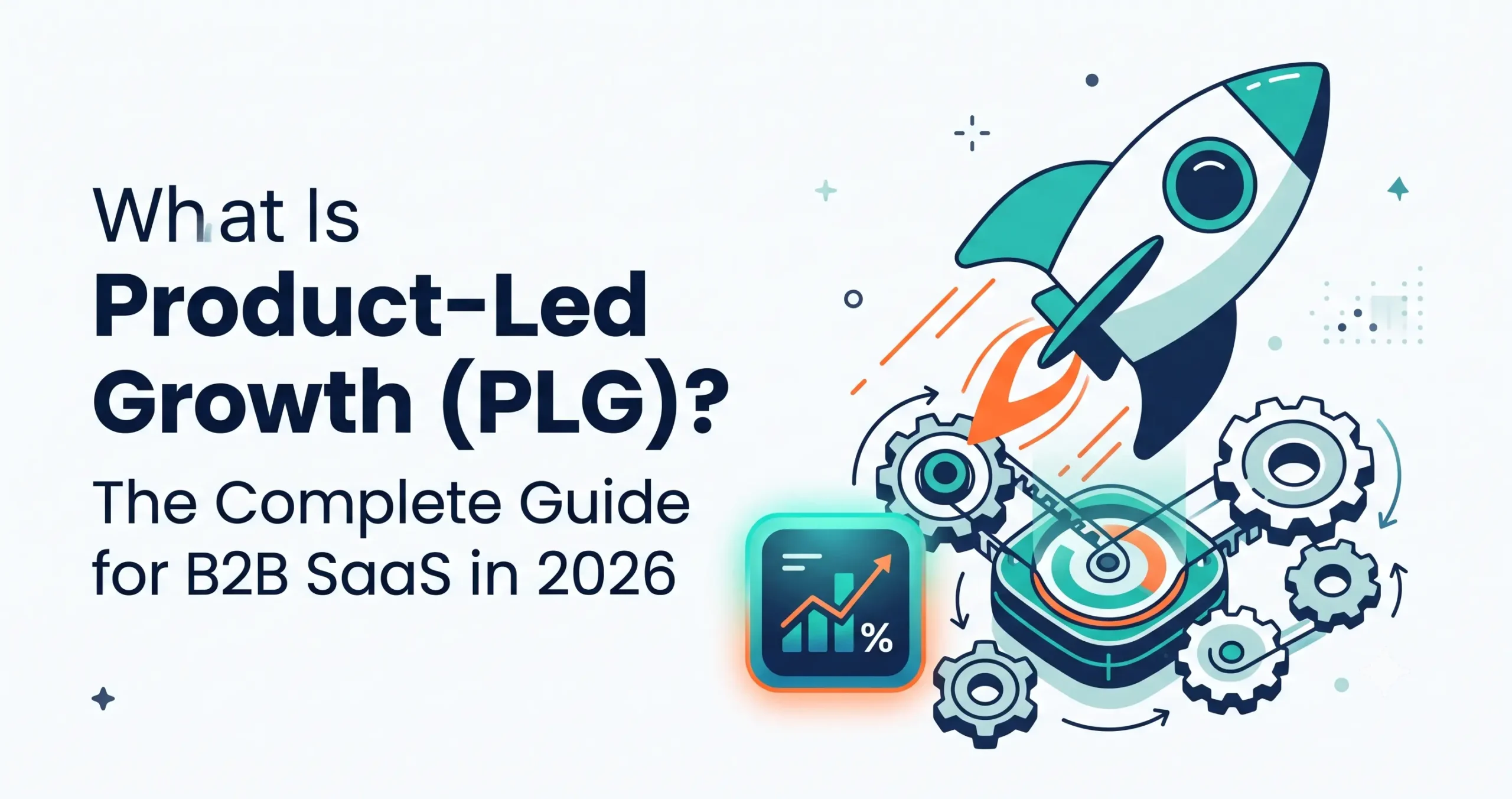
What Is Product-Led Growth (PLG)? The Complete Guide for B2B SaaS in 2026
As of 2026, over 70% of high-growth B2B SaaS companies have integrated product-led growth (PLG) into their revenue strategy—up dramatically from just a few years ago.
Gone are the days when buyers wanted to sit through three discovery calls just to see what a software dashboard looked like. Today, the modern B2B buyer expects to try before they buy. They want frictionless signups, instant value, and software that sells itself.
If your B2B SaaS company relies entirely on a traditional sales model, you are likely bleeding potential revenue. But what exactly is a product-led growth strategy, and how can you implement it?
Welcome to the ultimate guide on PLG for 2026.
What Is Product-Led Growth? (And How It Compares)
Product-led growth (PLG) is a business methodology where the product itself serves as the primary driver of customer acquisition, retention, and expansion.
Instead of relying on a sales team to pitch the software, PLG companies build products that users can easily discover, adopt, and purchase entirely on their own.
But how does it compare to other growth models?
- Sales-Led Growth: The traditional enterprise software model. Marketing generates leads, sales qualifies those leads, and reps close the deal. The user never touches the product until after the contract is signed.
- Marketing-Led Growth: Content, ads, and campaigns drive demand. The focus is on generating massive top-of-funnel traffic. However, without a strong product-led mechanism, this traffic still bottlenecks at the sales team.
- Product-Led Growth: The product is the main vehicle. Users enter via a free trial or freemium tier. They experience the value firsthand, and upgrade triggers are built directly into the UI.
The Core Principles of a PLG Strategy
Transitioning to product-led growth isn’t just about throwing a “Free Trial” button on your pricing page. It requires a fundamental shift in how your company operates.
Every successful PLG strategy is built on three core pillars:
1. Self-Serve Onboarding
Users must be able to sign up and start using the product without speaking to a human. This requires an intuitive user interface, contextual tooltips, and a frictionless signup process. If your product requires a 45-minute training session to understand, it isn’t ready for PLG.
2. Fast Time-to-Value (TTV)
Time-to-Value is the time it takes for a new user to realize the core benefit of your product. In a PLG model, TTV needs to be minutes, not weeks. The faster a user experiences that “Aha!” moment, the more likely they are to convert to a paid tier.
3. Built-In Expansion Loops
The product must naturally encourage users to upgrade or invite their colleagues. This could mean hitting a usage limit (e.g., max 100 contacts) or gating premium features behind a paywall. The product does the upselling for you.
Key PLG Metrics You Need to Track
To master product-led growth, you must track entirely different metrics than a traditional sales-led organization.
Here are the critical numbers you need on your SaaS dashboard:
- Activation Rate: The percentage of new signups who reach a specific milestone that indicates they’ve experienced value. (For example, in a project management app, activation might mean creating their first project and inviting a teammate).
- Time-to-Value (TTV): As mentioned, the time elapsed between signup and the user’s first activation milestone.
- Product-Qualified Leads (PQLs): A user who has experienced meaningful value in the product and matches your ideal customer profile. PQLs convert at a significantly higher rate than Marketing Qualified Leads (MQLs).
- Expansion Revenue: Revenue generated from existing customers upgrading their plans, buying add-ons, or adding more seats. In strong PLG companies, expansion often outpaces new logo revenue.
Industry Benchmark: Across the SaaS industry, a healthy free-to-paid conversion rate for a freemium model hovers around 2% to 5%, whereas a well-optimized opt-in free trial often converts at 15% to 25%.
Product-Led Growth Examples in Action
You likely use PLG software every single day without realizing it. Here are three classic, well-known examples of B2B SaaS companies that built multi-billion dollar valuations on product-led growth:
Slack
Slack didn’t grow by cold-calling IT departments. They grew by letting small teams adopt the software for free. Once a team hit their message search limit, they upgraded. Soon, whole departments were using it, forcing the enterprise to buy a company-wide license.
Calendly
Calendly is the ultimate example of a product with a built-in viral loop. When a user sends a Calendly link to book a meeting, the recipient experiences the product firsthand. The product acts as its own marketing engine.
Dropbox
Dropbox pioneered the referral loop. By offering free storage space in exchange for inviting a friend, they rapidly drove down their customer acquisition cost (CAC) and scaled globally without a massive sales team.
Step-by-Step Framework for Implementing PLG
Transitioning an existing SaaS product to a product-led motion is challenging but highly rewarding. Follow this framework to get started.
1.Define Your ‘Aha!’ Moment:Identify the core value.
Analyze your product data to find the exact action highly retained users take in their first week. If you are a CRM, it might be importing their first 50 contacts. This is your target activation event.
2.Remove Friction to Entry:Kill the discovery call.
Set up a 14-day free trial or a freemium tier. Remove required credit card fields on signup if possible, and strip down your registration form to just an email address and password.
3.Build an In-App Onboarding Flow:Guide the user.
Do not leave new users staring at a blank dashboard. Use tooltips, progress bars, and empty-state templates to guide them directly to the “Aha!” moment you identified in Step 1.
4.Define Your PQL Criteria:Align data with sales.
Determine what product usage signals indicate a user is ready to buy. For example: “Logged in 3 times in 5 days, invited a teammate, and hit 80% of their usage limit.”
5.Align Sales and Product:Close the loop.
Route your PQLs directly to your sales team for closing, or implement self-serve checkout flows for smaller accounts. Ensure your product team is constantly iterating based on where users drop off in the funnel.
Common Mistakes Companies Make When Adopting PLG
While the benefits are massive, many companies stumble during the transition. Avoid these common pitfalls:
- Forcing PLG on a Complex Product: If your software requires heavy integration, custom coding, or a massive data migration before it works, a pure self-serve model will fail.
- Ignoring the Human Element: Being product-led doesn’t mean firing your sales and support teams. It means redirecting them to high-value interactions.
- Gating the Wrong Features: If you put your core value proposition behind a paywall, free users will never experience the “Aha!” moment and will churn immediately. Gate advanced features, not core utility.
PLG vs. Sales-Led: When to Go Hybrid
It is a common misconception that companies must choose between product-led and sales-led growth. In reality, by 2026, most successful enterprise SaaS companies operate a hybrid model (often called Product-Led Sales).
Industry Benchmark: Financial data shows that public SaaS companies with a hybrid PLG motion consistently trade at higher revenue multiples and scale faster post-$10M ARR than their purely sales-led counterparts.
When to lean Product-Led:
- Your target audience is individual contributors or small teams.
- Your product is easy to set up and intuitive.
- Your Average Contract Value (ACV) is low, requiring a low Customer Acquisition Cost (CAC) to remain profitable.
When to lean Sales-Led (or Hybrid):
- Your software requires top-down executive buy-in.
- Deployment involves heavy IT security reviews or custom engineering.
- Your ACV is very high (e.g., $50,000+ per year).
In a hybrid model, the product handles the bottom-up adoption (acquiring end-users), while the sales team handles the top-down expansion (selling enterprise licenses to the C-suite based on existing product usage).
Frequently Asked Questions (FAQ)
1. What does PLG stand for?
PLG stands for Product-Led Growth. It is a business methodology where the product is the primary driver of acquisition, retention, and expansion.
2. Can enterprise software be product-led?
Yes. Many enterprise software companies use a hybrid model. They offer self-serve trials for individual teams (bottom-up), and then sales reps use that adoption data to sell enterprise-wide contracts (top-down).
3. What is the difference between PLG and freemium?
Freemium is a pricing strategy (offering a basic version for free indefinitely). PLG is a company-wide growth strategy. You can be a PLG company using only a 14-day free trial, without ever offering a freemium tier.
4. What is a Product-Qualified Lead (PQL)?
A PQL is a prospect who has already used your product, experienced its value, and hit specific behavioral triggers (like inviting a teammate) that indicate a high likelihood of upgrading to a paid plan.
5. Does PLG replace marketing?
No. Marketing is still crucial in a PLG model. However, instead of driving leads to a sales form, marketing drives traffic to sign up for the product itself. Marketing also plays a heavy role in lifecycle emails and user education.
Conclusion
Product-led growth is no longer just a buzzword—it is the baseline expectation for modern B2B software buyers in 2026. By focusing on self-serve onboarding, fast time-to-value, and letting your product do the heavy lifting, you can drastically lower acquisition costs and build a highly scalable revenue engine.
Ready to take the next step? To make PLG work, your users must understand your software from day one. Check out our related articles on NudgeSaaS covering best practices for user onboarding and how to optimize your activation metrics today.