How to Reduce SaaS Churn: 15 Proven Retention Strategies for 2026
If you are pouring resources into acquiring new users while existing customers quietly slip out the back door, you are fighting a losing battle. Customer churn is the silent killer of Software as a Service (SaaS) growth. While marketing and sales often dominate the conversation, retention is the true verdict on your product-market fit.
To understand how to reduce SaaS churn, you must first understand how it compounds against your acquisition efforts. Revenue you keep compounds for you; revenue you lose compounds against you. For example, a SaaS business with $5M in Annual Recurring Revenue (ARR) and a 3% annual logo churn only needs to replace $150,000 to stay flat. If that same business has a 10% annual churn rate, it must replace $500,000 just to tread water. In the highly competitive market of 2026, buyers and investors scrutinize net revenue retention closely—companies with a healthy churn profile often command valuation multiples that are two to three times higher than their high-churn counterparts.
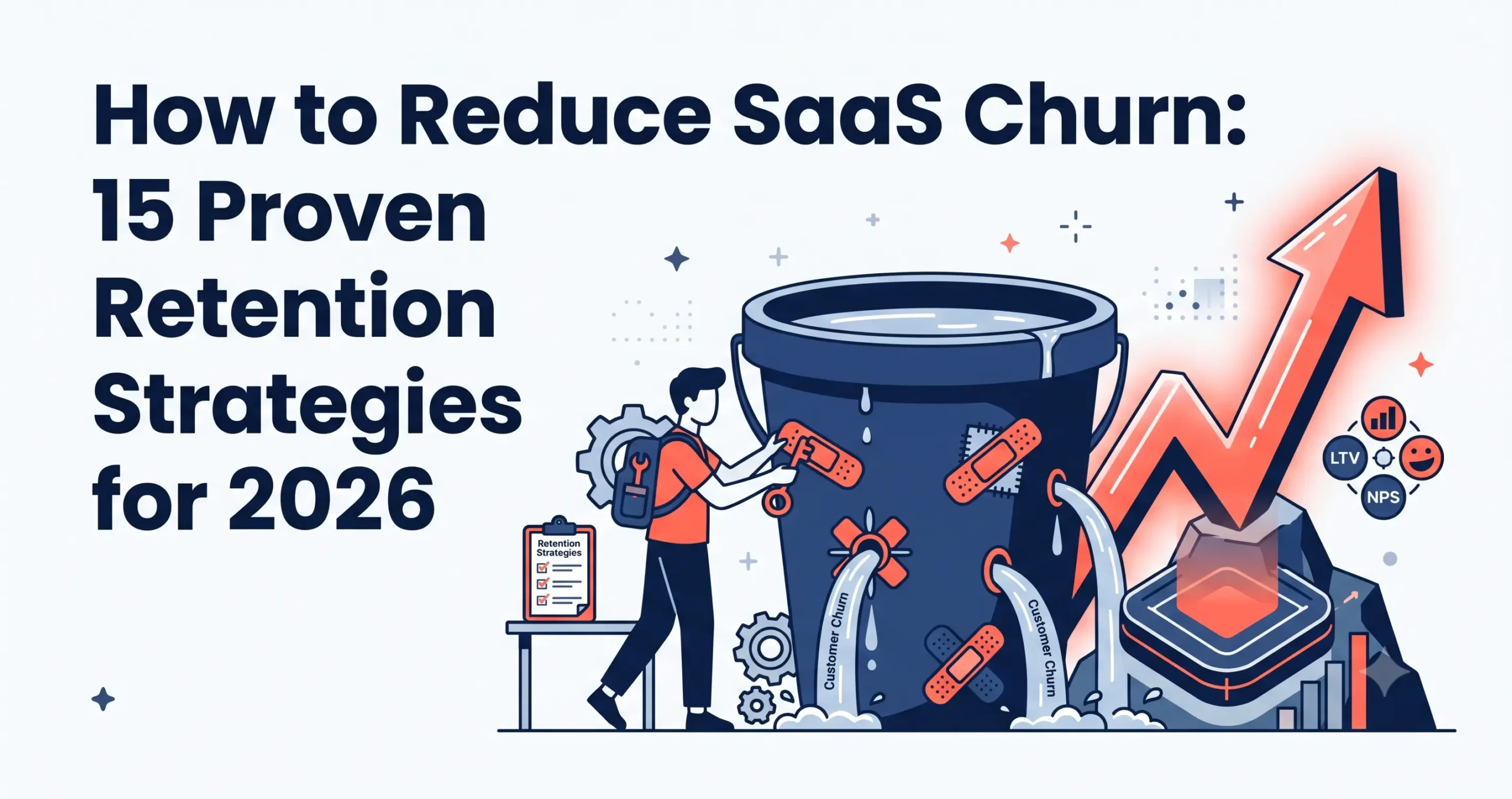
In this comprehensive guide for NudgeSaaS, we will break down how to calculate churn, analyze the latest 2026 industry benchmarks, and explore 15 actionable strategies to plug the leaks in your revenue bucket.
How to Calculate SaaS Churn
Before you can fix the problem, you need to measure it accurately. SaaS companies track two primary types of churn: Logo Churn (the loss of individual customers) and Revenue Churn (the loss of recurring dollars).
1. Customer (Logo) Churn Rate Formula
This metric tells you the percentage of total accounts that canceled their subscription during a specific timeframe.
Formula: (Number of Canceled Customers in Period ÷ Total Customers at the Start of Period) × 100
2. Net Revenue Churn Rate Formula
This is the financial truth of your business. It accounts for the Monthly Recurring Revenue (MRR) lost to cancellations and downgrades, but offsets it with MRR gained from upsells and cross-sells.
Formula: ((Lost MRR – Expansion MRR) ÷ Starting MRR) × 100
Note: If your expansion MRR is higher than your lost MRR, you achieve “negative net churn”—the holy grail of SaaS, meaning your company can grow even if you acquire zero new customers.
2026 SaaS Churn Rate Benchmarks
To know if your retention efforts are working, you need context. According to 2026 data analyzing over 500 B2B SaaS companies, the median monthly logo churn rate sits at 3.5%. However, this number varies wildly depending on your customer base and contract size.
Here is what “normal” looks like in 2026 across different company profiles:
| SaaS Segment | Average Monthly Churn | Key Drivers & Context |
| Early-Stage (<$1M ARR) | 5% – 7% | Still finding product-market fit; higher volatility. |
| SMB / Self-Serve | 3% – 8% | Budget constraints; high price sensitivity. |
| Mid-Market / Growth | 3% – 5% | Improved ideal customer profiles; moderate stickiness. |
| Enterprise (>$100K ACV) | 0.5% – 1% | Deep integrations and multi-year contracts limit churn. |
Roughly 2.6% of average monthly churn is voluntary (customers choosing to leave), while 0.8% to 0.9% is involuntary (failed payments and expired cards).
To help you visualize where your company stands against these benchmarks and calculate the long-term impact of your current retention rate, use this interactive tool:
15 Proven Retention Strategies for 2026
Reducing churn is not a single tactic; it is a holistic approach to the customer lifecycle. Here are 15 proven strategies to retain users and compound your growth.
1. Master Proactive Onboarding
The seeds of churn are often planted in the first two weeks. If a user signs up for your platform and fails to experience its core value quickly (Time-to-Value), they will abandon it. Proactive onboarding replaces overwhelming feature dumps with guided, goal-oriented setups.
- Practical Implementation Tip: Shift from time-based onboarding emails to milestone-based triggers. If a user completes Step 1 but ignores Step 2 for 48 hours, trigger an automated email containing a short video tutorial specifically addressing Step 2.
2. Implement Usage-Based Health Scoring
Relying on gut feelings or basic login data is insufficient. A customer might log in every day but only use 10% of your platform’s capabilities, meaning they are likely to downgrade. Health scoring combines multiple behavioral metrics into a single score (e.g., Green, Yellow, Red) to predict renewal likelihood.
- Practical Implementation Tip: Define your product’s “sticky features”—the specific actions that highly retained users take. Weight these heavily in your CRM’s health score. If a user stops using a sticky feature, the account should automatically flag as “Yellow” for your Customer Success team.
3. Monitor Early Warning Signals (Login Drop-Offs)
Customers rarely cancel out of the blue. They typically slowly disengage over weeks or months. By the time they hit the cancellation button, it is too late to save them. You must monitor early warning indicators, specifically consecutive login drop-offs and feature non-adoption.
- Practical Implementation Tip: Create a “Slipping Away” segment in your product analytics tool. Automatically route an alert to the account owner whenever an active user’s session time drops by 50% week-over-week.
4. Conduct Value-Driven Customer Success Check-Ins
Customer Success (CS) should not operate like a glorified technical support desk. If your CS team is only reacting to inbound tickets, you will lose accounts. Check-ins must be proactive and focused entirely on the customer’s return on investment (ROI).
Practical Implementation Tip: Frame check-ins around the customer’s original purchase intent. Instead of asking “How is everything going?”, start the call with: “You bought this software to reduce processing time by 20%. Let’s look at the dashboard to see if we are hitting that goal.”
5. Deploy Contextual In-App Nudges for Underused Features
Emailing users about a new feature often results in low engagement because the message arrives out of context. The best place to drive feature adoption is directly inside the application when the user is already trying to solve a problem.
- Practical Implementation Tip: Use in-app tooltips or modal windows to highlight underutilized tools, but tie them to user behavior. For example, if a user exports data to CSV five times in one week, trigger an in-app nudge showing them how to use your native reporting dashboard instead.
6. Ensure Pricing and Packaging Alignment
Pricing models play a massive role in retention. Flat-rate, all-you-can-eat pricing often leads to churn because light users feel they are overpaying, while heavy users strain your margins. In 2026, aligning your pricing with a specific “value metric” is standard practice.
- Practical Implementation Tip: Transition to a tiered or usage-based pricing model. If your software sends emails, charge per 1,000 emails sent. This allows small customers to stay on an affordable tier (reducing logo churn) while automatically capturing expansion revenue as they grow.
7. Automate Win-Back Campaigns for At-Risk Accounts
When a customer initiates the cancellation sequence, the battle isn’t completely lost. Automated win-back flows can salvage accounts by presenting tailored alternatives based on their stated reason for leaving.
- Practical Implementation Tip: Introduce a “Pause Subscription” feature in your cancellation flow. If a user cites “budget constraints” or “temporary project halt,” offer them the ability to pause billing for 1 to 3 months for a nominal fee, preserving their data and preventing a permanent churn event.
8. Build Relational NPS and Feedback Loops
Net Promoter Score (NPS) is a standard metric, but it is useless if it sits in a vacuum. The value of NPS lies entirely in the follow-up. You must distinguish between transactional NPS (rating a specific support interaction) and relational NPS (rating the overall brand).
- Practical Implementation Tip: Close the loop immediately. Automatically route any “Detractor” score (0-6) to a senior Customer Success Manager for a personal outreach call within 24 hours. Route “Promoter” scores (9-10) to marketing for case study requests.
9. Optimize Dunning Management for Failed Payments
Involuntary churn—where a customer loses access simply because a credit card expired or a payment failed—accounts for roughly 0.8% to 1.1% of all SaaS churn. Losing perfectly happy customers to administrative errors is entirely preventable.
- Practical Implementation Tip: Implement a pre-dunning sequence. Instead of waiting for a card to fail, send automated, personalized emails 30 days and 15 days before a credit card’s expiration date, offering a seamless one-click link to update their billing profile.
10. Invest in Community Building
Software is easily replaceable; relationships and peer networks are not. By building a community around your product, you create a “moat” that makes leaving your ecosystem incredibly difficult. Customers who engage in a community are consistently retained at higher rates.
- Practical Implementation Tip: Launch a private Slack group, Discord server, or dedicated forum for your paying users. Host monthly “Office Hours” where power users can share unique workflows and templates with newer users.
11. Develop Customer Education and Academies
The more deeply a customer understands your software, the more ingrained it becomes in their daily operations. Formal education programs transform casual users into internal champions who will advocate for your product if their CFO ever suggests cutting the budget.
- Practical Implementation Tip: Create a free “Certification Academy.” Offer badges that users can add to their LinkedIn profiles upon completing advanced training modules. Certified users carry immense switching costs, protecting you from churn.
12. Host Executive Business Reviews (EBRs) for Enterprise Accounts
For large-contract Enterprise SaaS, the person using your software daily is rarely the person holding the budget. Executive Business Reviews (formerly QBRs) are your opportunity to prove value to the economic buyer before renewal time.
- Practical Implementation Tip: Keep EBRs strictly strategic. Do not review support tickets or feature requests. Dedicate the entire 45-minute meeting to mapping your software’s metrics directly to the client’s overarching corporate goals (e.g., revenue generated, time saved, risk mitigated).
13. Systematize Exit Interviews and Churn Analysis
You cannot fix what you do not understand. When high-value accounts churn, an automated exit survey is not enough. You need qualitative data to uncover the root cause, which is often masked by generic “budget constraints” excuses.
- Practical Implementation Tip: Have a founder or senior executive conduct a 15-minute post-churn exit interview. Offer a $50 gift card for their time. Focus on finding out if they left for a competitor (product issue), lacked budget (pricing issue), or failed to launch (onboarding issue).
14. Treat Expansion Revenue as a Retention Signal
Upselling isn’t just about padding the bottom line; it is a profound indicator of product health. Customers do not buy add-ons, extra seats, or premium modules for software they intend to cancel.
- Practical Implementation Tip: Map out logical upgrade paths based on user milestones. If a marketing agency hits 80% of their client limit, trigger an automated sequence highlighting the workflow benefits of upgrading to the unlimited tier before they hit a friction point.
15. Build a Retention-Focused Company Culture
Churn is not just a Customer Success problem; it is a product, sales, and engineering problem. If Sales overpromises features to close a deal, CS will inevitably lose that customer 90 days later.
- Practical Implementation Tip: Tie executive bonuses and team KPIs across the entire company to Net Revenue Retention (NRR), not just net new sales. When the product team’s bonus depends on keeping users, they will prioritize fixing bugs and usability issues over simply shipping flashy new features.
Frequently Asked Questions (FAQ)
1. What is an acceptable SaaS churn rate in 2026?
For B2B SaaS, an acceptable baseline is an annual logo churn of 3% to 5% (roughly 0.3% to 0.5% monthly). Early-stage startups and B2C companies often see higher monthly churn rates (5% to 7%). Enterprise SaaS companies with large Annual Contract Values (ACVs) should aim for less than 1% monthly.
2. How long does it take to see results from a churn reduction strategy?
Because churn is a lagging metric, retention strategies rarely yield overnight results. Improvements to the onboarding process usually show in the data within 60 to 90 days. Deeper structural changes—like revamping your pricing model or shifting to annual contracts—may take 6 to 12 months to reflect fully in your net revenue retention numbers.
3. What is the difference between voluntary and involuntary churn?
Voluntary churn occurs when a customer actively decides to cancel their subscription due to dissatisfaction, budget cuts, or switching to a competitor. Involuntary churn happens passively, usually because a credit card expires, a bank declines a charge, or a billing system fails. In 2026, involuntary churn accounts for roughly 0.8% of the median 3.5% monthly churn rate, making it a highly addressable area for immediate improvement.
4. Should we focus more on reducing logo churn or driving expansion revenue?
Both are critical, but they serve different purposes. Reducing logo churn protects your base and validates your product-market fit. Driving expansion revenue (upsells/cross-sells) directly boosts your valuation. Investors ultimately care most about Net Revenue Retention (NRR). The ideal state is achieving over 110% NRR, meaning expansion outpaces your logo losses.
5. How often should we calculate and review churn?
While churn should be monitored constantly via real-time dashboards, it should be formally reviewed by leadership on a monthly basis. Furthermore, you should perform quarterly cohort analyses to see how retention rates change over time for specific groups of users (e.g., comparing users who signed up in Q1 versus Q2).