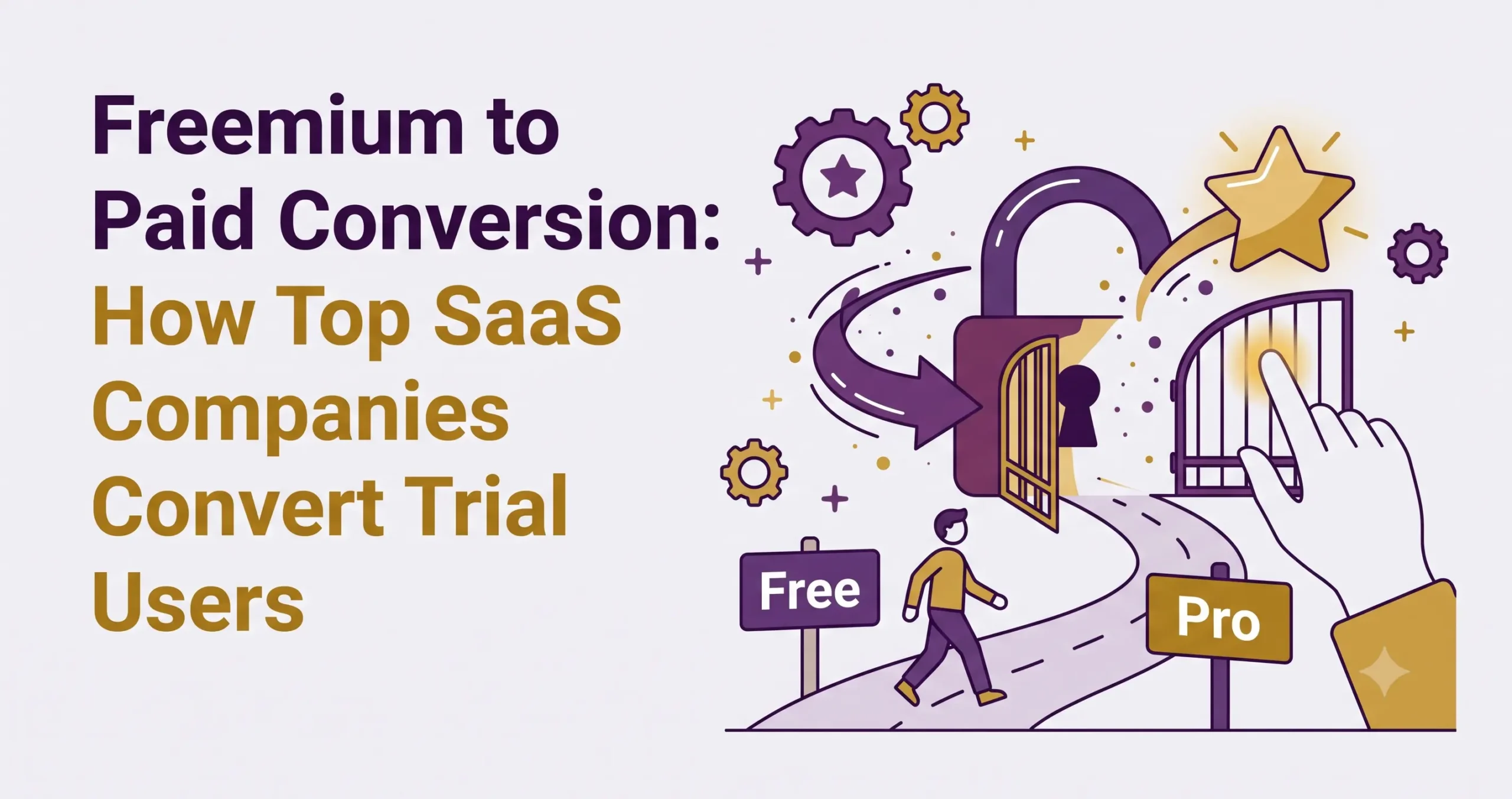
Freemium to Paid Conversion: How Top SaaS Companies Convert Trial Users
In the highly competitive world of Software as a Service (SaaS), acquiring users is only half the battle. In fact, an over-reliance on acquisition volume without an equal focus on conversion efficiency is the quickest way to drain your marketing budget. When companies optimize for top-of-funnel signups but fail to nurture those users into paying customers, they create a “leaky bucket” scenario. Optimizing your freemium to paid conversion matters substantially more than raw acquisition volume because it directly impacts your Customer Acquisition Cost (CAC) payback period, Customer Lifetime Value (LTV), and ultimately, your bottom line.
When you acquire thousands of free users who never open their wallets, you aren’t just missing out on revenue; you are actively incurring support, server, and administrative costs. Converting these users requires a nuanced understanding of product-led growth (PLG), behavioral psychology, and perfectly timed nudges. In this comprehensive guide by NudgeSaaS, we will explore the core methodologies behind free-to-paid conversion, unpack industry benchmarks, dive into the psychological triggers that prompt a credit card swipe, and break down 10 proven tactics used by the world’s most successful SaaS companies to convert trial users.
1. Freemium vs. Free Trial vs. Reverse Trial Models Explained
Before diving into conversion tactics, it is crucial to understand the structural differences between the three primary product-led acquisition models. The way you structure your free experience dictates how users perceive value and when they encounter friction.
The Freemium Model
Freemium provides users with access to a restricted version of your product indefinitely. The core features remain free forever, while advanced features, expanded capacity, or premium support are locked behind a paywall. Examples include Slack, Notion, and Mailchimp. The goal of freemium is to build a massive user base, generate brand awareness, and rely on natural usage expansion to drive upgrades. The downside? Users can grow so comfortable with the free tier that they never feel the need to upgrade.
The Free Trial Model
A free trial grants users access to the complete (or highly functional) version of the product for a limited time—typically 7, 14, or 30 days. Once the trial expires, the user must pay to continue using the software. Free trials create intrinsic urgency. They are highly effective for complex B2B products where users need to test advanced capabilities before committing. However, if a user fails to reach their “Aha!” moment within the trial window, they churn completely.
The Reverse Trial Model
The reverse trial represents the best of both worlds and is rapidly gaining popularity among elite PLG companies like Airtable and Canva. In a reverse trial, a user signs up and is immediately placed on a time-limited free trial of the premium tier. They get to experience all the advanced features right away. When the trial period ends, instead of being locked out entirely, their account downgrades to a standard freemium tier. This allows users to experience the “loss” of premium features (leveraging loss aversion) while keeping them engaged in the ecosystem if they aren’t ready to buy.
2. Average Conversion Rate Benchmarks by Model
Evaluating your freemium to paid conversion rate requires context. What looks like a failing metric in one model might be an industry-leading benchmark in another. While conversion rates vary wildly depending on industry (B2B vs. B2C), price point, and product complexity, here are the commonly cited industry ranges:
- Freemium Conversion Rates: Generally sit between 2% and 5%. Because the top of the funnel is inherently larger and unrestricted, the conversion rate is much lower. Exceptional companies (like Spotify or Slack) might push into the 7-10% range, but a 3-4% conversion rate is considered highly healthy for standard SaaS.
- Free Trial (Opt-in / No Credit Card Required): If users can start a trial without a credit card, expect a conversion rate between 15% and 30%. This lower friction at signup means you get more trialists, but lower initial intent.
- Free Trial (Opt-out / Credit Card Required): If users must provide payment details to start the trial, the signup volume will drop significantly, but the conversion rate will skyrocket to 50% to 75%. These users have already demonstrated high purchasing intent.
- Reverse Trial: Conversion rates here tend to blend the two, typically hovering around 8% to 15% of the total user base. The higher conversion compared to traditional freemium is driven by the early exposure to premium value.
Note: Chasing an arbitrarily high conversion rate isn’t always the goal. If your freemium conversion rate is 15%, your free tier might be too restrictive, artificially stunting your overall user growth and word-of-mouth acquisition.
3. The Psychology of the Free-to-Paid Decision
Transitioning a user from a free account to a paid subscription is rarely about logical feature comparison. It is fundamentally a psychological shift. Top SaaS companies engineer their user journeys around three core psychological pillars: Value Realization, Habit Formation, and Urgency.
Value Realization (The “Aha!” Moment)
Users do not pay for software; they pay for outcomes. The “Aha!” moment is the exact point in the user journey where the abstract promise of your marketing copy translates into concrete, experienced value. For Zoom, it’s hosting a flawless first meeting. For Expensify, it’s scanning a receipt and seeing the data auto-populate. To drive freemium to paid conversion, you must design your onboarding sequence to push users toward this moment as rapidly as possible, before you ever ask them to upgrade.
Habit Formation
According to Nir Eyal’s Hook Model, long-term user retention (and subsequent monetization) requires building a habit. Your product needs to become the default solution to a recurring user trigger. Once a product is woven into a user’s daily workflow, switching costs (both technical and cognitive) increase. When users are habituated to your interface, upgrading to a paid tier to solve a new friction point feels infinitely easier than evaluating a competitor.
Urgency and Loss Aversion
Humans are neurologically wired to fear losing something they already have more than they desire gaining something new (loss aversion). Time-limited trials and reverse trials tap directly into this. When the trial clock is ticking down, the user faces the imminent loss of data, capabilities, or workflow efficiency. This artificial urgency forces a decision. Without urgency, freemium users will defer the purchasing decision indefinitely.
4. 10 Proven Tactics to Accelerate Upgrades
Understanding the theory is important, but execution is what drives revenue. Here are ten highly actionable, proven tactics used by elite SaaS companies to optimize their freemium to paid conversion pipelines.
1. Usage Limits That Create Natural Upgrade Moments
Instead of locking specific features, limit the volume of usage. This is known as a value metric. For instance, Slack limits message history to 90 days. Dropbox limits storage space. HubSpot limits the number of marketing contacts. Usage limits align pricing directly with customer success; the more they rely on your tool, the more they pay.
- Action Step: Identify a metric that scales with the value your customer receives (e.g., API calls, active users, projects, storage). Set your free tier limit just below the threshold where a user transitions from casual exploration to serious business reliance.
2. Strategic Feature Gating
Feature gating involves keeping the core functionality free while locking advanced capabilities—such as custom branding, advanced analytics, integrations, or priority support—behind a paywall. This allows users to solve their base problem but requires them to pay for enterprise-grade efficiency.
- Action Step: Analyze your product usage data. Identify “power user” features that are rarely used in the first week but are heavily used by long-term retained customers. Gate these features, as they represent the tipping point of professional intent.
3. In-App Upgrade Nudges at Peak-Value Moments
Timing is everything. Do not bombard a user with an upgrade modal the moment they log in. Instead, trigger in-app nudges contextual to their actions. If a user tries to export a high-resolution video in a free editor, show the upgrade prompt exactly when they click “Export.”
- Action Step: Map out the user journey and identify moments of high intent. Implement contextual, non-intrusive tooltips or modals that explain exactly how the paid tier solves the specific friction they are experiencing in that exact moment.
4. Time-Limited Trial Urgency
If you are operating a standard free trial, visibility into the expiration timeline is critical. If users forget their trial is ending, they will feel blindsided when their access is revoked, leading to frustration rather than conversion.
- Action Step: Add a persistent, unobtrusive countdown banner at the top of your app interface (e.g., “7 days left in your Pro trial”). As the deadline approaches, change the color of the banner from neutral to a warning color (like amber or red) to increase psychological urgency.
5. Personalized Upgrade Emails Triggered by Usage Behavior
Generic “Your trial is ending” emails are easily ignored. Instead, trigger emails based on specific user behavior. If a user has repeatedly hit a paywall for a specific feature, send them an email highlighting a case study of how a customer used that exact feature to generate ROI.
- Action Step: Integrate your product analytics with your email automation platform. Create segmented email tracks tailored to the specific features a user interacted with most during their free experience. Focus the messaging on outcomes, not features.
6. Sales-Assisted Conversion for High-Intent Free Users
Not all conversions need to be entirely self-serve. Product Qualified Leads (PQLs) are users who have experienced meaningful value in the free product and match your ideal customer profile (ICP). Engaging these users with a human touch can drastically increase conversion rates and initial deal size.
- Action Step: Set up a lead scoring system based on product usage and firmographic data. When a user crosses the PQL threshold, route them to your sales or customer success team for a personalized, consultative outreach rather than a hard pitch.
7. Injecting Social Proof at the Paywall
When a user hits a paywall or a checkout page, they experience friction and doubt. This is the exact moment they need reassurance that they are making the right decision. Social proof mitigates buyer’s remorse before it even happens.
- Action Step: Redesign your upgrade modals to include subtle but powerful social proof. Add a high-profile customer logo, a one-sentence testimonial, or a metric like “Join 50,000+ teams upgrading their workflow.”
8. Transparent and Frictionless Pricing Pages
Confusion kills conversion. If a user cannot immediately understand which plan they need or how much it will cost, they will bounce. Complex pricing tiers, hidden fees, and ambiguous feature lists create unnecessary cognitive load.
- Action Step: Audit your pricing page. Ensure the transition between tiers is logical. Highlight the “Most Popular” plan to leverage the decoy effect. Use plain English to describe features and clearly state what happens if they exceed limits.
9. The Onboarding-to-Paid Handoff
Great onboarding shouldn’t stop once a user learns the interface; it should naturally transition into making a business case for the premium tier. The onboarding flow should set up workflows that naturally scale into paid territory.
- Action Step: Implement an in-app checklist. The first few items should guide them to the “Aha!” moment. The final item on the checklist should be an action that reveals the immense value of a premium feature, smoothly transitioning them toward a purchase decision.
10. Win-Back Offers for Lapsed Trials
When a trial expires without a conversion, the lead isn’t dead. Often, the timing just wasn’t right. The user might have been too busy to evaluate the software properly. Abandoning lapsed trials leaves money on the table.
- Action Step: Set up an automated sequence that triggers 30, 60, and 90 days after trial expiration. Offer a one-time trial extension (“We saw you didn’t get a chance to fully explore the app. Here’s 7 more days on us”) or a targeted, time-bound discount to reignite their interest.
5. How to Design a Paywall That Doesn’t Feel Punitive
A paywall is a critical conversion mechanism, but it can easily become a source of profound user frustration if handled poorly. When a user clicks a button and is abruptly met with a hard “UPGRADE NOW” block, it feels punitive—as if they are being punished for exploring the software. To optimize freemium to paid conversion, your paywalls must feel like natural, value-additive extensions of the experience.
First, never obscure the fact that a feature is premium. Use visual indicators (like a small crown icon, a lock symbol, or a different color) on gated features so users know what to expect before they click. Transparency builds trust.
Second, when the paywall modal triggers, the copy should focus entirely on the benefit the user was trying to achieve. Instead of saying, “This feature requires a Pro Plan,” reframe it as, “Want to automate this workflow and save 3 hours a week? Upgrade to Pro to unlock Advanced Automations.” Pair this with clear, one-click pathways to enter credit card details or view the full pricing page. The transition from product interaction to payment should be as frictionless as possible.
6. Essential Metrics to Monitor
To successfully optimize your conversion engine, you need to track the right data. Measuring the success of your tactics relies on three foundational metrics:
- Trial-to-Paid Conversion Rate: The percentage of users who start a trial and eventually purchase a subscription. Track this on a cohort basis (e.g., users who signed up in January) to measure the impact of product updates over time.
- Time-to-Convert: The average number of days it takes for a free user to become a paying customer. In a freemium model, this might take months; in a 14-day trial, it should be under two weeks. If your time-to-convert is shortening, your value realization engines are working efficiently.
- Expansion Revenue After Conversion: It’s not just about getting the first dollar. Track Net Revenue Retention (NRR) to see if converted users continue to upgrade their tiers, add more seats, and increase their lifetime value. A user who converts and then churns in month two is a sign of a mismatched product promise.
Frequently Asked Questions (FAQ)
1. Should we require a credit card upfront for our free trial? It depends on your goals. Requiring a credit card yields fewer signups but massively higher conversion rates (50-75%) because it filters out low-intent users. If your goal is broad market capture and user feedback, remove the credit card requirement. If your sales and support teams are overwhelmed by low-quality leads, add the friction.
2. How long should a free trial last? The ideal trial length matches how long it takes a user to experience your product’s core value. For simple utility apps (like a PDF editor), 7 days is plenty. For complex B2B platforms (like a CRM) that require data migration and team buy-in, 14 to 30 days is standard. Urgency drives action, so shorter is often better if value realization is fast.
3. Is a freemium model better than a free trial? Neither is inherently better; they serve different strategic purposes. Freemium is an acquisition play aimed at building a massive user base and creating network effects (e.g., Zoom, Slack). Free trials are a conversion play aimed at closing high-intent buyers faster. Many modern SaaS companies use a Reverse Trial to blend the benefits of both.
4. How do I know which features to gate behind a paywall? Use product analytics. Core features that define the basic utility of your app should be free. Features that indicate enterprise maturity—such as Single Sign-On (SSO), advanced analytics, custom branding, integrations with premium tools, or multiple user roles—should be gated. You want to monetize businesses, not casual tinkerers.
5. What is a Product Qualified Lead (PQL)? A PQL is a user who has experienced meaningful value in your product using a free or trial account, making them highly likely to upgrade. Unlike a Marketing Qualified Lead (MQL) who just downloaded a whitepaper, a PQL has actively engaged with your core features, hit usage thresholds, or fit an ideal firmographic profile based on their in-app behavior.